
A Valley Oak Starts It’s Journey At Trees That Please Nursery.


The Valley Oak (Quercus lobata) is native to California and has slow to moderate growth reaching up to 40′-50′ tall and wide. It’s leaves are similar to our native Gambel Oak. Leaves display yellow brown fall color. Like most oaks it has deep roots and it is long-lived. The Valley Oak grows best with regular water. Trees That Please Nursery propagates the Valley Oak because it does very well in clay soils and high water table areas.

The picture below shows how a Valley Oak starts it’s journey at Trees That Please Nursery. Acorns from locally grown trees were collected and refrigerated until use. At planting we dust emerging roots with a mycorrhizal inoculant called White Lightning®.


White Lightning® contains Glomus intraradices an Arbuscular Mycorrhizae species and 8 species of Ectomycorrhizae.  Glomus intraradices associates with the vast majority of agricultural short term crops! Ectomycorrhizae associate with many conifers (i.e. hemlocks, firs and spruce) and hardwoods (i.e. pecans and oaks).

For a complete list of plants and how mycorrhizae associate with them,
visit the Soil Secrets web site at:


We inoculate our oaks with White Lightning®  mycorrhizae because of the many benefits they provide including the following:

Increased crop yields
Improved drought tolerance
Improved uptake of mineral nutrients
Improved food nutrient density
Increased Phosphorus uptake
Improved tolerance to environmental stress

For information about this product visit the Soil Secrets Website at:


After acorns are inoculated they are placed into flats
containing a well-drained soil mixture.


Acorns are covered with soils and flats are then grown
 in our heated greenhouse until spring.
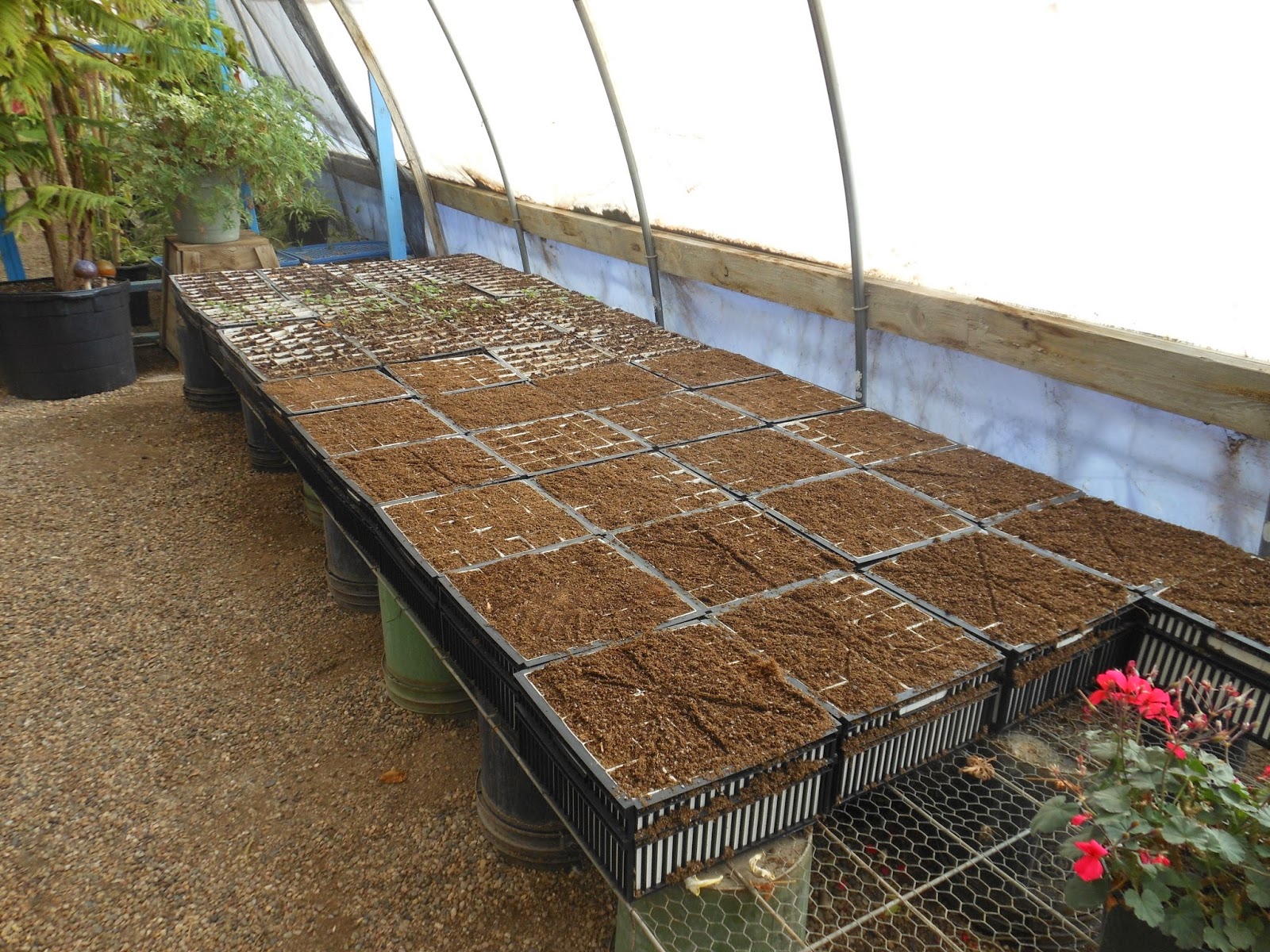


In the spring, flats are moved to our production facility for further growth and development. 

Photos & Narrative By:
Stephen Sain 
Staff Plant Physiologist

Trees That Please Nursery
Unique Amongst Retail and Wholesale Nurseries

Serving Albuquerque, Santa Fe, Los Lunas, and Belen

Comments

Anonymous said…
I would not call Valley oak slow. We regularly see mature trees with trunks 4 plus feet thick adding 3 to 4 feet of new growth on every branch in the area around Davis California. Your owner Michael showed us a young tree that reached 40 tall in 10 years in Fred Traugers yard in Albuquerque.
Anonymous said…
Michael, show us the picture of Fred's tree in his front yard. I've also seen several at your own arboretum in Los Lunas that have reached 40 feet in a dozen years with a big one about 50 feet tall that was planted from seed in January of 1989. Not slow growing at all and in fact champions of fast growth as far as quality hardwood trees are concerned.

Popular posts from this blog

Question: How close to my house can I plant a Cottonwood tree?

Cottonwoods grow to be immense trees attaining dimensions of up to 40 - 50 feet tall and wide with a root system to match. Cottonwoods have a surface root system that can heave sidewalks, crack walls and home foundations if planted too close. Cottonwoods should be planted a minimal distance from structures of at least 25 feet if not further. Trees That Please Nursery carries two varieties of cotton-less, Cottonwood Trees. Please contact us or stop by the store for more information.

Afghan Pine

The Afghan Pine ( Pinus eldarica ) is also known as Desert Pine, Eldarica Pine or Mondell Pine. Afghan Pine is native to low rainfall areas of Afghanistan, Pakistan, and southern Russia . In fact, when planted in areas of high rainfall (> 20” per year), it becomes susceptible to a number of diseases and rapidly declines. This problem has occurred in East Texas.   The Afghan Pine thrives in heat, wind, and tolerates drought. Afghan Pine must be planted in soils with good drainage like sand. It is not suitable for poorly drained heavy clasy soils. Afghan Pines are generally pyramidal or Christmas tree shaped in form when young   becoming more oval or irregular with age. The leaves of the Afghan Pine are evergreen needles usually found in groups of 2 per fascicle or sheath. Needles are shed after several years and make excellent mulch as they fall around the trees base.   It has attractive trunk bark that becomes dark and furrowed with...

WEED IDENTIFICATION: SAND BUR

Sand Bur ( Cenchrus longispinus ) is native to North America. It has other names like  sand spur, long-spined sand bur, hedgehog grass, and bur grass . Sand Bur is an annual grass usually growing with a prostrate growth form. It is similar in appearance to other grasses prior to seed formation. Individual plants may be 3’ in diameter, sometimes larger.  Sand Bur is a common weed of sandy soils but also grows well elsewhere. Sand Bur will often root at stem nodes that are touching the ground. The root system of Sand Bur is shallow and fibrous making them easily pulled (when immature). Sand Bur produces a flowering spike. As seeds begin to form Sand Bur is easily recognized by its numerous sharp or burred seeds or long spines. As the burred seeds mature they are easily separated from the mother plant and their sharp spines stick to virtually anything. Sand Bur can disseminate its seeds long distances because its sharp spines will hitch a ride on skin, animal hides, sho...